The UK has the world’s highest taxes for airline passengers, known as the Air Passenger Duty (APD). What is Air Passenger Duty? It’s an excise duty charged on passengers flying from airports in the United Kingdom or Isle of Man, first introduced in 1994 by then-chancellor Kenneth Clarke.
As we navigate through 2026, understanding Air Passenger Duty and its significant impact on travel costs has become essential for anyone flying from UK airports. Originally implemented at just £5 for European destinations and £10 for flights outside Europe, the tax has since evolved into a complex structure with rates now reaching as high as £224 for ultra-long-haul premium cabin travel. Additionally, APD serves a dual purpose – generating over £3 billion in revenue (2019-20) while also aiming to offset the environmental impact of air travel by discouraging unnecessary flights.
Throughout this guide, we’ll break down everything you need to know about UK Air Passenger Duty – from how it’s calculated based on travel distance and cabin class to who must pay it and when exemptions apply. Whether you’re planning business travel or a luxury getaway, we’ll help you understand what type of tax Air Passenger Duty is and how to factor these costs into your 2026 travel budget.
What is Air Passenger Duty and why does it exist?
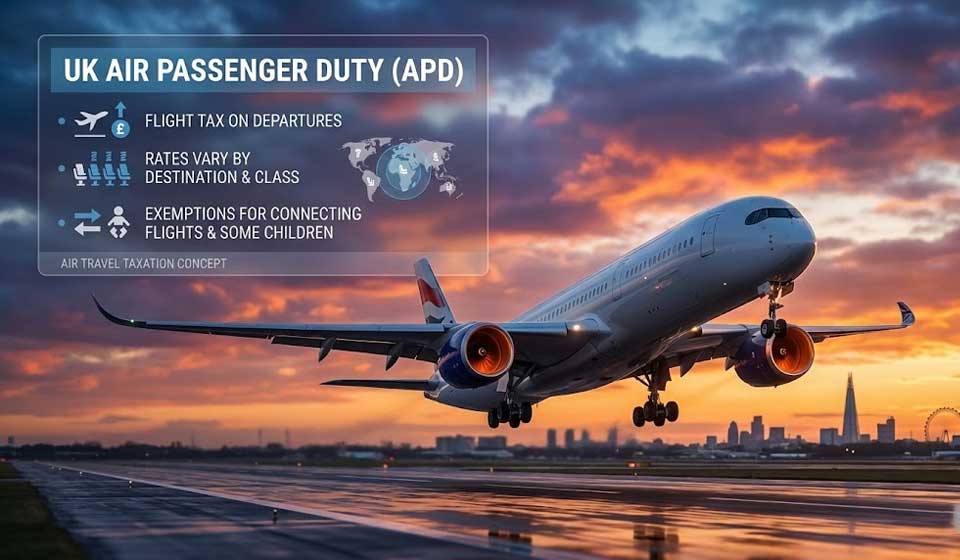
“UK-APD applies to all passengers departing the UK on fixed-winged aircraft weighing 5.7 tons or more.” — Universal Weather and Aviation Services, Aviation industry compliance and guidance provider
Air Passenger Duty remains unique among aviation taxes, serving as the UK government’s primary method of taxing air travel. Originally established as an excise duty charged on passengers flying from UK and Isle of Man airports on aircraft exceeding 5.7 tons or with more than 20 passenger seats.
A brief history of APD in the UK
Kenneth Clarke introduced Air Passenger Duty in the November 1993 Budget, with implementation beginning on November 1, 1994. The initial structure was straightforward:
- £5 for flights within the UK and European Economic Area
- £10 for flights to other destinations
The tax underwent significant restructuring in April 2001, introducing different rates for economy versus premium cabins. In 2007, Gordon Brown doubled all duty rates, followed by a major overhaul in 2009 that created four geographical distance bands. Further refinement occurred in 2015, consolidating to just two bands, before expanding again to four bands in April 2023 (one domestic and three international).
What type of tax is Air Passenger Duty?
Air Passenger Duty functions specifically as an excise duty, classified as a departure tax rather than a direct environmental levy. Furthermore, the UK Office for Budget Responsibility estimates APD will generate approximately £4.7 billion in 2025-26, representing 0.4% of all government receipts. Despite higher rates for premium travel, most revenue comes from economy passengers because over 90% of flights involve travel in classes subject to the reduced rate.
Why APD was introduced instead of fuel tax
APD emerged as a practical alternative to traditional fuel taxation. In fact, Clarke implemented APD because he considered it “anomalous” that fuel duty wasn’t levied on air transport, but international agreements prevented him from taxing aircraft kerosene. Consequently, APD offered a solution by taxing passengers directly.
For those planning Group/VIP Travel, understanding these 2026 APD rates becomes particularly important as they represent a substantial portion of your travel costs. Similarly, if you’re looking to minimize tax exposure, our Empty Leg Flights can offer savings of up to 75% on total flight costs.
How Air Passenger Duty is calculated in 2026
“This applies to passengers with itineraries originating in the United Kingdom, and the tax ranges from £13 for an international short haul economy flight, to £224 for an international premium cabin long haul flight.” — One Mile at a Time Editorial Team, Aviation and travel industry analysis publication
The calculation of Air Passenger Duty involves several factors that determine the final tax amount passengers pay when flying from UK airports. Understanding these variables helps travelers anticipate the additional costs on their 2026 flights.
Distance-based destination bands (A, B, C)
In 2026, APD uses a four-band structure based on the distance between London and the destination country’s capital city:
- Domestic band: Flights within England, Scotland, Wales, and Northern Ireland
- Band A: 0-2,000 miles (covering Europe, EEA countries, and North Africa)
- Band B: 2,001-5,500 miles (including destinations like Egypt and the Maldives)
- Band C: Over 5,500 miles (ultra-long-haul destinations)
For connecting flights, the final destination determines the band, not intermediate stops—unless you spend over 24 hours at a transit point.
Class of travel and seat pitch rules
APD rates vary based on seating arrangements:
- Reduced rate: Economy class with seat pitch under 40 inches (1.016 meters)
- Standard rate: Premium cabins or seats with pitch exceeding 40 inches
- Higher rate: Special rate for certain aircraft (detailed below)
Seat pitch is measured from any point on one seat to the same point on the seat in front.
Domestic vs international flight rates
For 2026, the official rates are:
- Domestic: £7 (reduced), £14 (standard), £84 (higher)
- Band A: £13 (reduced), £28 (standard), £84 (higher)
- Band B: £90 (reduced), £216 (standard), £647 (higher)
- Band C: £94 (reduced), £224 (standard), £673 (higher)
Looking ahead, these rates will increase notably in 2026, making Empty Leg Flights even more attractive for cost-conscious travelers.
Special rules for private jets and business aircraft
Currently, the higher rate applies to aircraft of 20 tons or more equipped for fewer than 19 passengers. From April 2027, however, this threshold will drop to 5.7 tons, meaning nearly all private jet passengers will pay the higher rate regardless of aircraft size. For those considering Executive Charters, these changes represent significant cost implications.
Who pays APD and when it applies
APD primarily affects anyone flying from a UK or Isle of Man airport on aircraft weighing over 5.7 tons or with more than 20 passenger seats.
Passengers subject to the tax
Essentially, all passengers on chargeable aircraft must pay APD, whether they’ve paid for their ticket or not. The tax follows an operator-based collection system where airlines collect the duty from passengers during booking, subsequently remitting it to HMRC within 29 days after the end of the accounting period. For those concerned about minimizing travel costs, our Empty Leg Flights offer opportunities to reduce overall expenditure.
Exemptions: children, crew, and special cases
Several key exemptions exist:
- Children under 2 without their own seat (all classes)
- Children under 16 traveling in the lowest class only
- Flight crew and cabin attendants
- Passengers in transit who don’t change aircraft
- NATO forces on official business
Moreover, humanitarian flights, search-and-rescue operations, and flights from the Scottish Highlands and Islands enjoy full exemption.
When APD is charged and how it’s collected
The duty crystallizes only when passengers actually fly. For those utilizing Executive Charters, operators typically handle all tax obligations, filing returns monthly or through special accounting schemes.
Refunds: when and how to claim back APD
You can request APD refunds for unused tickets directly through your airline. Each carrier has different procedures—generally through online forms or customer service.
Estimate your APD cost or check flight pricing
Understanding how much Air Passenger Duty you’ll pay helps in planning your travel budget effectively. UK APD varies significantly across different routes and cabin classes, making it crucial to calculate these costs beforehand.
Why APD varies by route and class
APD costs differ primarily based on:
- Distance bands: Domestic (£7), Band A (£13), Band B (£90), and Band C (£94) for economy travel in 2026
- Cabin class: Premium cabins nearly double the tax (£14-£224)
- Seat pitch: Economy seats with pitch under 40 inches qualify for reduced rates
For those traveling on private jets, rates climb dramatically to between £84-£673 depending on destination.
How to estimate your total tax before booking
First, identify your destination band based on the capital city’s distance from London. Second, determine your cabin class. Finally, check the corresponding rate from the latest APD tables.
For connecting flights, remember the tax applies to your final destination, not intermediate stops—unless you spend over 24 hours at a transit point.
Use this tool to check your flight cost
Several online calculators like PaxTax help operators compute passenger-oriented taxes. Nevertheless, most airlines include APD directly in ticket prices during booking.
For travelers seeking to minimize tax exposure, our Empty Leg Flights offer savings up to 75% compared to standard Executive Charters.
Conclusion
Air Passenger Duty undoubtedly represents a significant consideration for anyone traveling from UK airports. Throughout its evolution since 1994, this tax has grown from a modest £5-£10 charge into a complex four-band system reaching up to £224 per passenger in 2026. Therefore, factoring APD into your travel budget becomes essential, particularly for long-haul flights and premium cabin bookings.
Understanding your specific APD obligations depends on several key factors. First, your destination band (Domestic, A, B, or C) substantially impacts the tax amount. Second, your cabin class and seat pitch determine whether you pay reduced or standard rates. Additionally, certain exemptions exist for children, transit passengers, and specific flight operations.
Airlines typically handle APD collection during booking, though refunds remain available for unused tickets. Looking ahead to 2026, these rates will increase further, making strategic flight planning even more valuable. Empty Leg Flights offer an excellent alternative for cost-conscious travelers, potentially saving up to 75% compared to standard charter options.
The environmental dimension of APD cannot be overlooked. While originally implemented as an alternative to kerosene taxation, APD nonetheless serves as a deterrent to unnecessary air travel. Still, business and luxury travelers seeking to minimize their tax exposure while maintaining flexibility should consider Executive Charters or Group/VIP Travel options tailored to their specific requirements.
UK Air Passenger Duty remains the highest aviation tax globally, yet understanding its structure allows travelers to make informed decisions. After all, proper planning around these unavoidable taxes helps optimize travel budgets without compromising your journey quality or destination choices.




)